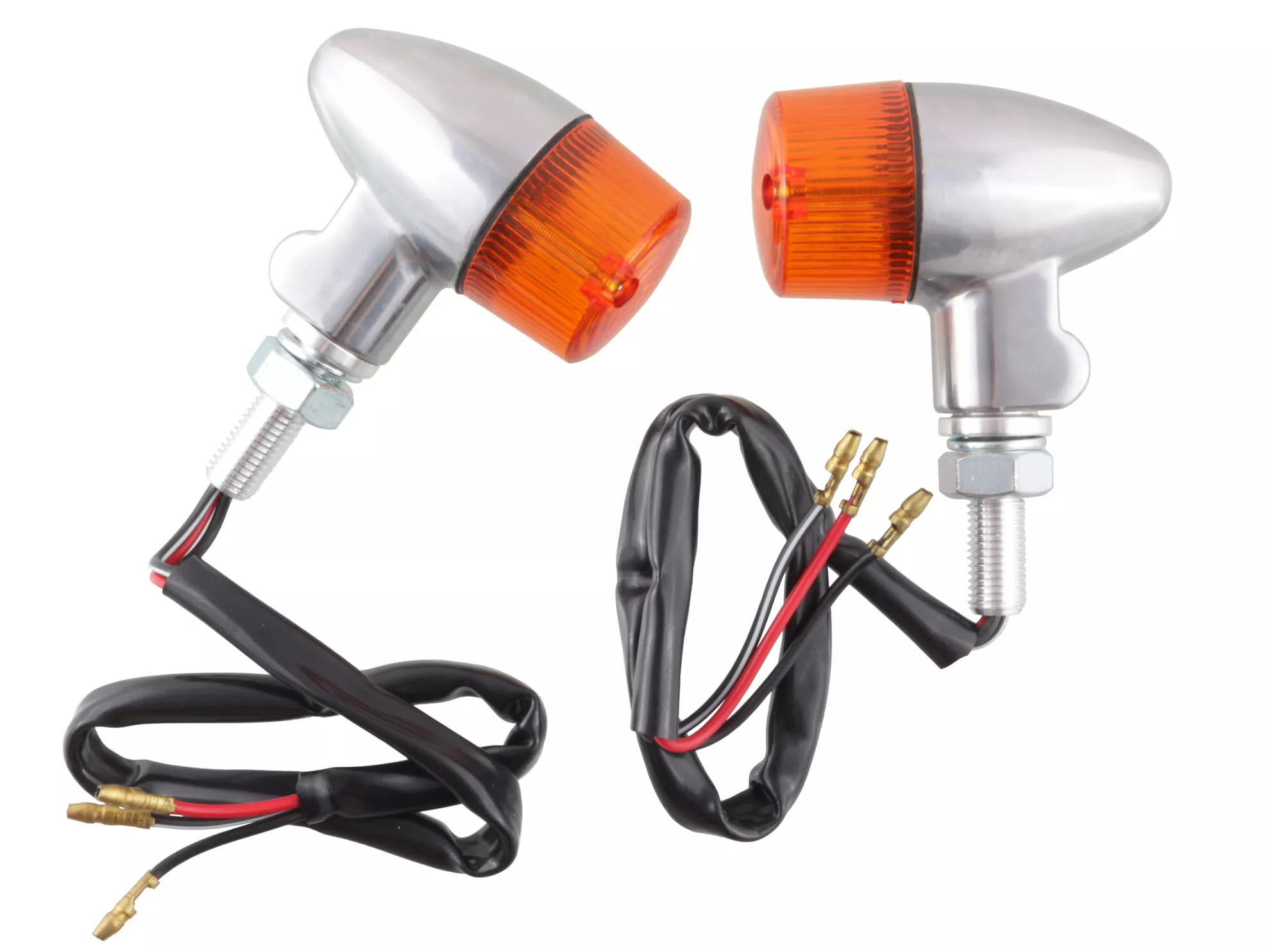
Aluminum Bullet Turn Signals (Pair)
Original price was: $36.00.$20.86Current price is: $20.86.
13 in stock
Description
Aluminum Bullet Turn Signals for Vintage Honda Motorcycles
Upgrade the lighting on your vintage Honda with these aluminum bullet-style turn signals. Each pair features a single-piece aluminum body available in polished chrome or black, with a 12V dual-filament 1157 bulb that functions as both a turn signal and a running light. Pre-wired with Honda-style bullet connectors for a clean, plug-compatible installation on CB175, CB200, CB350, CB360, CB450, CB500T, CB500K, CB550, and CB750 models (1965–1978).
Why You Need This
Original turn signal assemblies on vintage Hondas are often cracked, faded, or missing entirely. These aluminum bullet signals are a direct stem-mount replacement that fits the factory signal stems with a nut-and-washer clamp—just like the OEM signals. The compact bullet profile sits tighter to the bike than stock housings, giving the front and rear a cleaner look without requiring custom brackets or fabrication. The dual-filament 1157 bulb means you get both turn signal and running light capability in one unit, so bikes with post-1974 running light circuits (CB360, CB550, CB750) are fully covered. For single-circuit bikes (CB175, CB350, CB450, CB500K), you simply cap off the running light wire.
Pair these with a Headlight Bucket & H4 Bulb Kit and a set of Headlight Brackets for a complete front-end lighting refresh.
Specifications
| Sold As | Pair (2 turn signals) |
|---|---|
| Body Material | Single-piece aluminum |
| Finish Options | Polished Chrome (3208) or Black (3209) |
| Bulb Type | 12V dual-filament, 1157 low-profile (included) |
| Filaments | Turn signal + running light |
| Light Diameter | 1.5″ |
| Overall Depth | 2.75″ |
| Mounted Length | 2.5″ |
| Stem | 30mm x M10 (1.2″ length) |
| Mount Type | Stem mount with nut and washer (clamps onto separate stem, like OEM) |
| Seal | Gasket included for weather sealing |
| Connectors | Honda-style bullet connectors (pre-wired) |
Important Notes
- These signals use a 12V dual-filament 1157 bulb. If you are converting to LED bulbs, you will need an Electronic Flasher Relay to get the correct flash rate—the stock thermal relay depends on incandescent current draw to cycle.
- The stem mount design clamps onto the existing turn signal stem on your bike. These do not include the stems themselves—they use your original mounting stems or aftermarket replacements.
- The included 1157 bulb is a low-profile style. Standard full-size 1157 bulbs will also work but may sit slightly taller in the housing.
Model-Specific Notes
- CB175 / CB350 / CB450 / CB500K (pre-1974): These bikes use a single-circuit turn signal system—no running lights. Wire the black (ground) and black/white stripe (turn signal) leads. Cap off the red (running light) wire with a crimp cap or electrical tape.
- CB360 / CB550 / CB750 (1974 and later): These bikes have a running light circuit per DOT regulations introduced around 1974. Wire all three leads: black (ground), black/white stripe (turn signal), and red (running light). The running lights stay on whenever the key is turned on.
- CB200: The CB200 bridges both eras—the 1973 CB200K0 uses a single-circuit setup, while the 1974+ CB200T has the running light circuit. Check your wiring harness at the headlight bucket for a running light wire to confirm which setup your bike has.
- CL and SL Scramblers: All CL175, CL200, CL350, CL360, CL450, SL175, and SL350 models are compatible. Same wiring rules apply based on year (pre-1974 = single circuit, 1974+ = dual circuit).
Installation
- Remove the old turn signal from the mounting stem (unscrew the retaining nut).
- Disconnect the original wiring at the bullet connectors inside the headlight bucket or under the seat (rear signals).
- Slide the new aluminum bullet signal onto the stem and secure with the included nut and washer.
- Connect the wiring using the Honda-style bullet connectors:
- Black → Ground
- Black w/ White Stripe → Turn signal circuit
- Red → Running light circuit (cap off on single-circuit bikes)
- Turn the key on and test both left and right signals. Confirm the flash rate is correct—if signals flash too fast or too slow, check your flasher relay.
Related products
-
- Sale!
- hot sale
Yadea Elite Prime & KS Series AC Charging Cord (OEM)
- Original price was: $3.20.$1.80Current price is: $1.80.
- Add to cart
-
- Sale!
- hot sale
Battery charger UL/ USA (Gen 2.0)
- Original price was: $19.96.$12.07Current price is: $12.07.
- Add to cart
-
- Sale!
- hot sale
Yadea KS5 & KS5 Pro Kickstand – Genuine OEM
- Original price was: $7.20.$4.60Current price is: $4.60.
- Add to cart
-
- Sale!
- hot sale
Cup Holder Universal Mount Kit
- Original price was: $28.80.$21.70Current price is: $21.70.
- Add to cart
-
- Sale!
- hot sale
Knobby tire 12.5″ (Gen 2.0)
- Original price was: $28.00.$18.12Current price is: $18.12.
- Add to cart
-
- Sale!
- hot sale
Xtender Power Assist
- Original price was: $5,267.64.$3,896.27Current price is: $3,896.27.
- Add to cart
-
- Sale!
- hot sale
Yadea KS3 & KS3 Lite Front Fender – Yellow OEM Replacement
- Original price was: $4.00.$3.14Current price is: $3.14.
- Add to cart
-
- Sale!
- hot sale
V-brake pads (Gen 2.0)
- Original price was: $7.16.$4.88Current price is: $4.88.
- Add to cart