
Valve Adjustment Kit | Honda CB360 / CB550
Original price was: $12.00.$7.98Current price is: $7.98.
59 in stock
Description
Valve Adjustment Kit | Honda CB360 / CB550
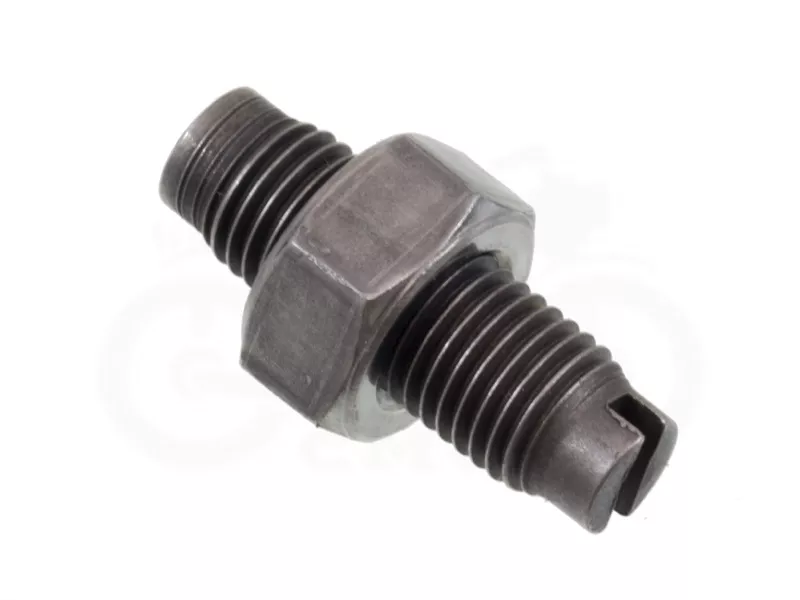
Pull the valve covers on a fifty-year-old Honda and the adjusters are often chewed up, seized, or gone altogether. We have seen bikes missing every adjuster and lock nut in the head and still running. These are new replacements, sold as an adjuster screw and its lock nut together.
Why You Need This
The adjuster screw is what sets the gap between the rocker arm and the valve stem, and the lock nut is what keeps that setting where you put it. A rounded slot or a stripped thread means you cannot hold a setting, and a valve that drifts is the one that costs you. Too tight is what does damage; too loose only makes noise.
You set these every 1,500 miles (2,400 km) as part of our standard tune-up, in the order of cam chain first, then valves, then ignition timing.
Specifications
| Spec | Detail |
|---|---|
| Replaces OEM Parts | 90012-426-000, 90012-300-000, 90206-250-000 |
| Fits Models | CB360G/T (1974–1976), CL360 (1974–1975), CJ360T (1976–1977), CB500K (1971–1973), CB550K (1974–1978), CB550F (1975–1977) |
| Sold As | Sold Individually — one adjuster screw with its lock nut |
How many you need: a CB360 twin has four adjusters, two per cylinder. A CB500K or CB550 four has eight. Each unit here is one adjuster screw with its lock nut, so order the quantity your engine takes.
Valve Clearance Specs
Both engine families run the same numbers, set cold.
| Model | Intake | Exhaust |
|---|---|---|
| CB360 / CL360 / CJ360 | 0.05 mm (0.002 in.) | 0.08 mm (0.003 in.) |
| CB500K / CB550K / CB550F | 0.05 mm (0.002 in.) | 0.08 mm (0.003 in.) |
The exhaust side runs looser on purpose. Exhaust gas puts more heat into that side, so the metal expands further once the engine is hot.
Installation
Difficulty: Intermediate
Tools needed: flathead screwdriver, feeler gauge, offset box wrench (10mm on the CB360)
- Start cold. Pull the valve covers to reach the adjusters.
- Bring the cylinder you are working on to the top of its compression stroke. A finger over the spark plug hole will tell you — you will feel the air push out.
- On the CB360, line the rotor up on the LT mark for the left cylinder, then rotate 180 degrees to the T mark for the right. On the CB500K and CB550, set half the valves at number one TDC, then rotate one full turn for the rest.
- Back off the lock nut. The adjuster is a slotted screw, so a flathead holds it while you work.
- Set the gap with the feeler gauge, then tighten the lock nut while holding the screwdriver still. If the screw turns as the nut goes tight, the setting is gone.
The trick we use: go one gauge size up and set it snug rather than trying to feel a perfect slip fit. A 0.003 in. blade on an intake and a 0.004 in. blade on an exhaust, tightened until the gauge just drags, lands the clearance where it should be. Chasing an exact feel is how valves end up too tight.
An offset box wrench earns its place here. A straight wrench fights the surrounding castings; the offset gets on the nut and still leaves you room for the screwdriver and the feeler gauge at the same time.
Related products
-
- Sale!
- hot sale
Inner tube for 12.5″ tire (Gen 2.0)
- Original price was: $12.00.$6.78Current price is: $6.78.
- Add to cart
-
- Sale!
- hot sale
Battery charger UL/ USA (Gen 2.0)
- Original price was: $19.96.$12.07Current price is: $12.07.
- Add to cart
-
- Sale!
- hot sale
Yadea KS3, KS5 & KS5 Pro LED Headlight – Genuine OEM
- Original price was: $7.20.$4.00Current price is: $4.00.
- Add to cart
-
- Sale!
- hot sale
Yadea KS3 & KS3 Lite Front Fender – Pink OEM Replacement
- Original price was: $4.80.$2.94Current price is: $2.94.
- Add to cart
-
- Sale!
- hot sale
Cup Holder Universal Mount Kit
- Original price was: $28.80.$21.70Current price is: $21.70.
- Add to cart
-
- Sale!
- hot sale
Yadea Trooper 01 Chain Tensioner – Genuine OEM
- Original price was: $23.20.$14.92Current price is: $14.92.
- Add to cart
-
- Sale!
- hot sale
YADEA COCOA REAR WHEEL ASSEMBLY
- Original price was: $199.20.$102.45Current price is: $102.45.
- Add to cart
-
- Sale!
- hot sale
Empulse R20 Power Assist
- Original price was: $1,567.80.$1,164.94Current price is: $1,164.94.
- Add to cart